SPECIAL STUDY · TRAVEL AND RESEARCH HISTORY

The Longing
for Palenque

Four routes to a long-hidden city — and the question of what travellers, artists and researchers preserved for those who came after them.

Rolf BeckerHistoric travel accountsPalenque · Chiapas
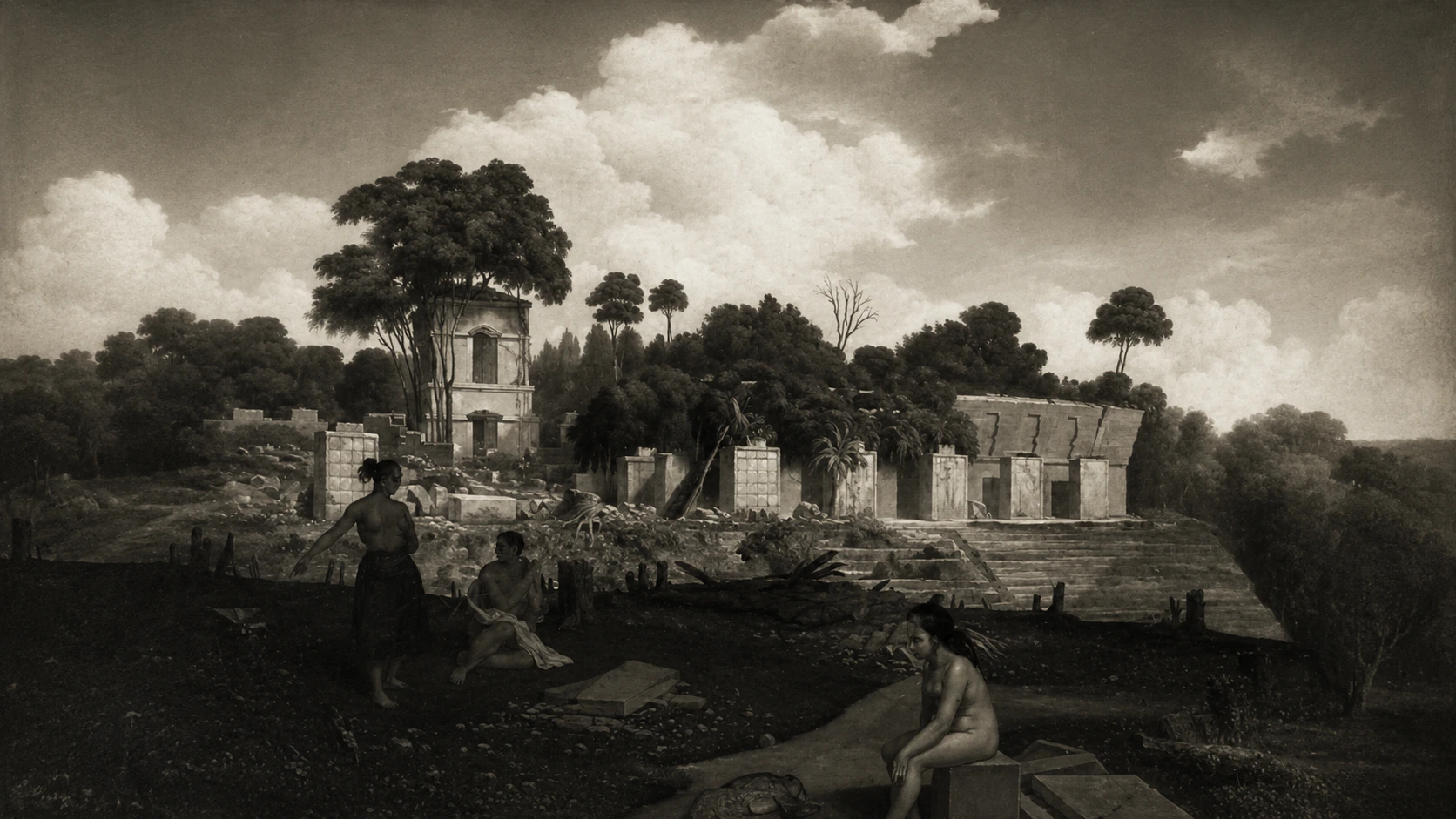
Historic artistic view of Palenque
Visual preludeA romanticised nineteenth-century view of the ruins evokes how powerfully Palenque fired the historical imagination long before modern archaeology.
Central perspective
“Every route to Palenque is also a route through changing ideas.”

The study reads journeys as documents: terrain, expectation and historical context shaped what travellers saw, drew and believed.

THE BOOK AT A GLANCE

A journey into the history of rediscovery.

The book follows more than the people who sought Palenque. It follows their routes, their ways of seeing and the traces their accounts left behind.

Rolf Becker sets the historic journeys to Lakamha — Palenque beside the observations recorded on site by explorers, soldiers, diplomats, artists and scholars. The result is a double portrait: the difficult approach to a remote place and the history of its documentation, from early descriptions and romanticised drawings to increasingly precise records and comparisons.

4 routesmajor expeditions structure the narrative
3 centuriesof travellers, scholars and changing viewpoints
1 sitereappearing in records, drawings and memory
FOUR ROUTES TO LAKAMHA

Four expeditions.
Four perspectives.

The study approaches Palenque along different routes and shows how travel conditions, historical context and personal expectations shaped what visitors saw and how they described it.

01
1832 · LA FRONTERA → PALENQUE

Count Waldeck

Jean-Frédéric Waldeck returns to Palenque after years of engagement with Mexican antiquities. He lives for an extended period in a simple hut among the ruins and records buildings and reliefs in striking drawings, some coloured by romantic and Old World ideas.

02
1839–1840 · BELIZE → PALENQUE

Walker & Caddy

Patrick Walker and John Herbert Caddy leave Belize in haste under the British flag and reach Palenque roughly three and a half months before Stephens and Catherwood. Caddy’s drawings record the site precisely, while their official report remains obscure in colonial archives for generations.

03
1839–1840 · BELIZE · COPÁN → PALENQUE

Stephens & Catherwood

John Lloyd Stephens and Frederick Catherwood combine diplomacy, adventure and systematic documentation. Their published account and Catherwood’s exact drawings bring Palenque to an international readership and preserve details later lost.

04
1895 · CIUDAD DEL CARMEN → PALENQUE

William H. Holmes

Holmes approaches Palenque from the Gulf through lagoons and rivers. Steamship, launch, dugout canoe, horseback travel and jungle paths make the landscape part of the narrative. His group spends four days examining the ruins.

THE CENTRAL IDEA

Not only discovery.
Also memory.

The power of the book lies in comparison: what could one traveller still see in his time, and what remained decades later? Historical records become witnesses to gradual loss as well as to the development of archaeological understanding.

The route

Distance, rain, rivers, jungle, illness and political uncertainty turn the approach itself into part of the history.

The gaze

Every expedition views Palenque through the knowledge and assumptions of its own era. Some interpretations now seem strange; precisely for that reason they reveal how research evolved.

The record

Accounts, plans, drawings and later photographs preserve states that jungle, climate and collapse altered or erased altogether.

The history of Palenque is also the history of those who tried to reach it, see it and preserve it for later generations.A guiding idea distilled from the study
FROM REDISCOVERY TO DOCUMENTATION

Palenque appears layer by layer.

The book places the later research journeys within a longer development, from early missionary encounters and Spanish expeditions to the international travellers of the nineteenth century.

1567Fray Pedro Lorenzo de la Nada founds Santo Domingo de Palenque; reports of stone buildings slowly enter the colonial record.
1780sSpanish expeditions begin to describe and draw ruins, reliefs and buildings more systematically.
1830s–1840sWaldeck, Walker–Caddy and Stephens–Catherwood turn Palenque into a subject of international research and public fascination.
1895William H. Holmes approaches the site with the perspective of a museum scholar and anthropologist from a later generation.

What the reader takes away

The ruins are not presented as a static monument but as a place whose appearance continuously changes. A lost relief, collapsed façade or overgrown structure can survive in an earlier drawing even when it no longer exists on site.

That is why the study combines travel history with source criticism. Early researchers preserve invaluable details while also carrying their errors, speculations and cultural assumptions into the documents they leave behind.

The result is a book about adventure and scholarship, but equally about impermanence: Palenque is rediscovered again and again in historical voices while jungle and time continue to transform its material remains.

THE PALENQUE CHRONICLES

One city. Many ways of seeing. Four routes into the past.

The study makes clear why Palenque held generations of travellers, artists and scholars in its grip — and why their records have themselves become part of the history of the site.

BACK TO PUBLICATIONS →